Music and songs in particular, have been part of our voting culture since the start of the nation, and for as long as politics have been recounted, music was always a part of the process. Whether it be an upbeat wind band march to call potential voter’s attention to a city-center tree stump for a candidate to explain his position, to the political satire of Mark Russel and his piano cutting like a knife through the murky rhetoric of blustery candidates to the concert performances by renowned divas and rock stars at the inaugural celebrations, music grabs people’s attention, gives us something artful we can all agree on while setting the tone for the event.
Just weeks away from one of the most contentious presidential elections in US history, while still in the midst of a once in a century global pandemic and threatening a global economic recession, I wonder what the students think about the state of the world that adults have created for them today?
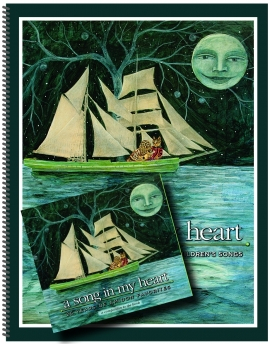
I first heard the song “Vote for Me” on the Amidon’s Album “A Song in My Heart” and every autumn, as we approach election day in November, this song rises inside me as a “must do” age appropriate tune that speaks to what our vote as citizens is all about. Often I think of my individual vote as my personal voice in the governing of the country I live in. It’s my one chance to give actionable feedback to the executive leadership of our nation. The song “Vote for Me” widened my eyes about the power of my vote as a parent, educator and leader. Written from the perspective of a child, the lyrics ask adults to vote with the long-term vision of our nation’s children in mind, similar to John Feierabend’s 30-year plan to grow musically rich adults who are tuneful, beatful and artful. I’m excited to be using this song this election season with at home online learning.
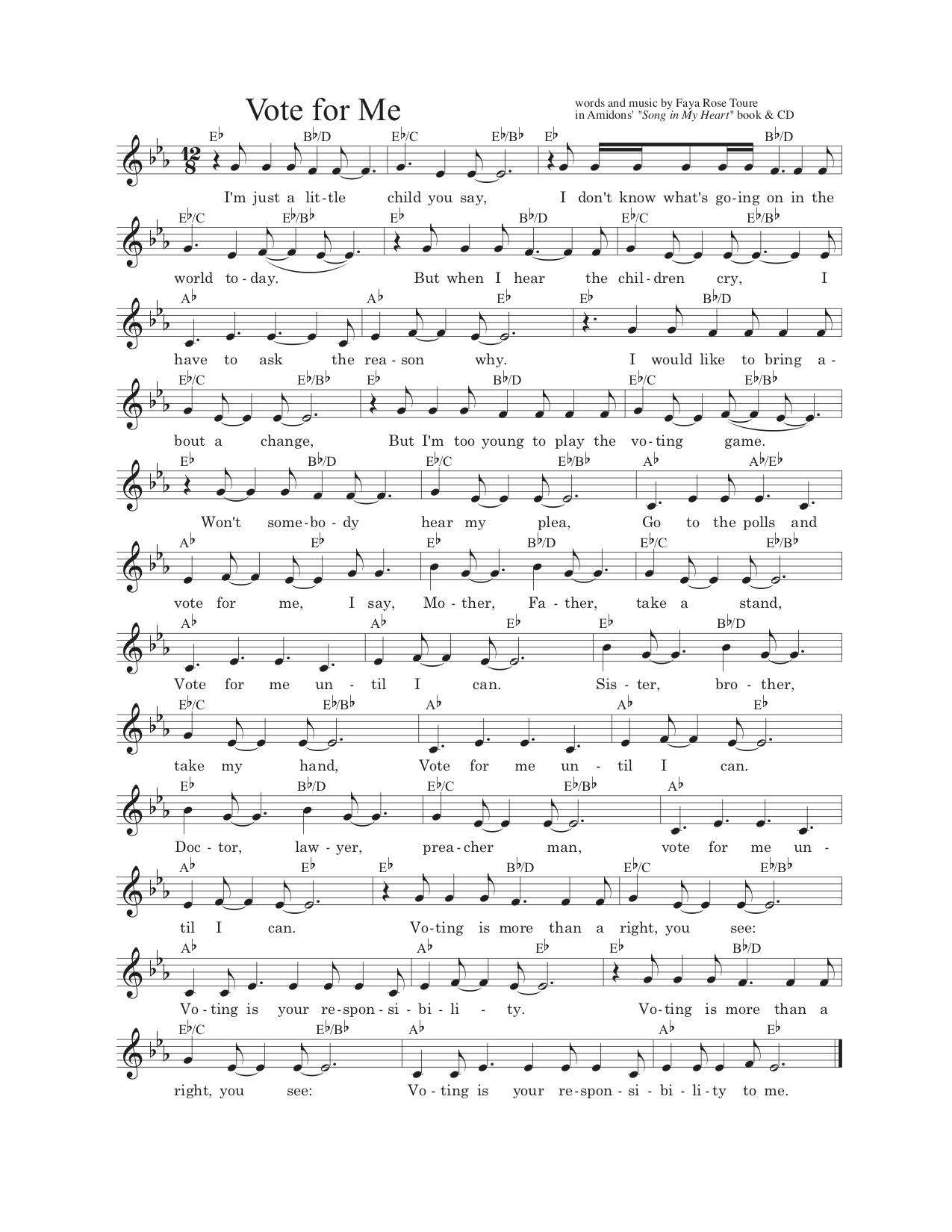
Link to a full size PDF of the song
I wrote Peter Amidon asking for permission to reference his family’s recording of the song. Peter writes:
“Vote For Me” is written by Faya Rose Touré* (also known as Faya Rose Sanders), an American civil rights activist, educator, lawyer, and songwriter who lives in Selma, Alabama. She was born and raised in North Carolina, and in 1969 she went to the Harvard Law School. Faya Rose Touré worked on a number of high profile civil rights cases during her law career including the case of Pigford v. Veneman, the largest civil rights case in history. She founded the National Voting Rights Museum; the Ancient Africa, Slavery and Civil War Museum; and the 21st Century Youth Leadership Movement. Faya Rose Touré was Alabama’s first African-American female judge.”
Peter goes on to write, “when Becky Graber wrote to ask permission to sing her song for a project, Faya Rose Touré replied, and I quote:
“Of course you have my permission and blessing to sing “Vote for me” for when I wrote it, I wrote it to share. I truly support what you are doing, I am so happy that you are telling the story”.” Reprinted with permission from Peter Amidon.
When Peter and Mary Alice Amidon made the recording, their sons Sam and Stefan Amidon pleaded with listeners to vote for them. I have to admit, the first two times I listened, while driving down the highway, and wondered to myself “what office are they running for?” Listen on Youtube. 2
Here’s a recent recording made for the Women Sing 100 Virtual Song Festival held on September 13, 2020, celebrating the 100th anniversary of the 19th Amendment to the constitution. I really like this version because it demonstrates Peter’s virtual choir tutorial and how we can keep our communities singing together during this time of Covid19.
In my classrooms we sing a lot, probably because some of my strongest musical memories of my own childhood were singing in class with the teacher at the start of the day, after lunch recess and in music class. Throughout the school-year, I share singing packets of age and seasonally appropriate songs that I teach and sing with students in each class. Over time this becomes the school repertoire that I can call on at any time for an all school sing, emergency coverage of a class, a PTA tea party or whenever the mayor calls and asks for children to sing, opening up an event. It was good advice that my mentors gave me to always start the year out with one month of review of known concepts and songs from the previous year and to review and teach the patriotic songs in September, so the students have a ready repertoire that can easily be shared off-site at Veterans Day commemorations in cemeteries or at the American Legion halls. In recent years, I’ve been looking to replace a couple of my go to patriotic standards with songs that have more inclusive lyrics and represent the views and feeling of all Americans. “Vote for Me” is one of those songs that fit the purpose. The Lyrics go:
“I’m just a little child, you say
I don’t know what’s going on in the world today
But when I hear the children cry
I have to ask the reason why
I would like to bring about a change
But I’m too young to play the voting game
Won’t somebody hear my plea
Go to the polls and vote for me
I say: mother, father, take a stand
Vote for me until I can
Sister, brother, take my hand
Vote for me until I can
Doctor, lawyer, preacher man,**
Vote for me until I can
Voting is more than a right you see
Voting is your responsibility
Voting is more than a right you see
Voting is your responsibility to me
I’ve worked much of my career in communities where many students had limited access to much of what we take for granted in suburban communities. One of the gray area inequities I’ve observed is the informal mentorship that students receive simply by interacting with a variety of different sorts of adults who are achieving their long term dreams. For many of my pupils, the only people they regularly interact with who went to college are their school teachers. When I heard elementary music teacher Daniel Potter from West Windsor, NJ put up this online lesson for his students last spring, 3 it got me thinking, again this year, about a line near the end of this lyric and the words I ask my own students to sing.
What I really like about Daniel Potter’s rendition of the song is on the second half of the refrain, he replaces the lyric “Doctor, lawyer, preacher man,” with “People all across this land, calling everyone eligible to vote to the polls, not for themselves, but the future of the children of the nation.
According to the Pew Research center, less that 63% of the eligible voting population show up to cast a ballot. When elections continue to hinge on one percent of the popular vote, this year more than ever, I have to wonder the reason why? I know I’ll be singing this song every opportunity I get, as we push into the homes of our students with online distance learning. A great day would be if we could have entire families learning this song and posting it back with Seesaw videos.
*If you attended the 2018 FAME Biennial conference in Chicago, you may remember our keynote speaker Nick Page leading a night of community singing and the memorable moment with this other well know Faya Rose Touré song: “I’m Gonna Lift My Sister Up, She is Not Heavy”
**“Doctor, lawyer, preacher man,” could be substituted with “People all across this land.”
 John Crever is a FAME teacher trainer, musician, educator and parent based in Portland, Oregon where he plots his Tuneful, Beautiful, Artful takeover of the western states.
- Amidon, Peter Amidon, Mary Alice, A Song in My Heart: book & CD, Amidon Music Publishing, 2013
- “Vote for Me – Sam Amidon & Stefan Amidon”
- “Voting Song (Vote for Me) – Daniel R.J. Potter”