Description
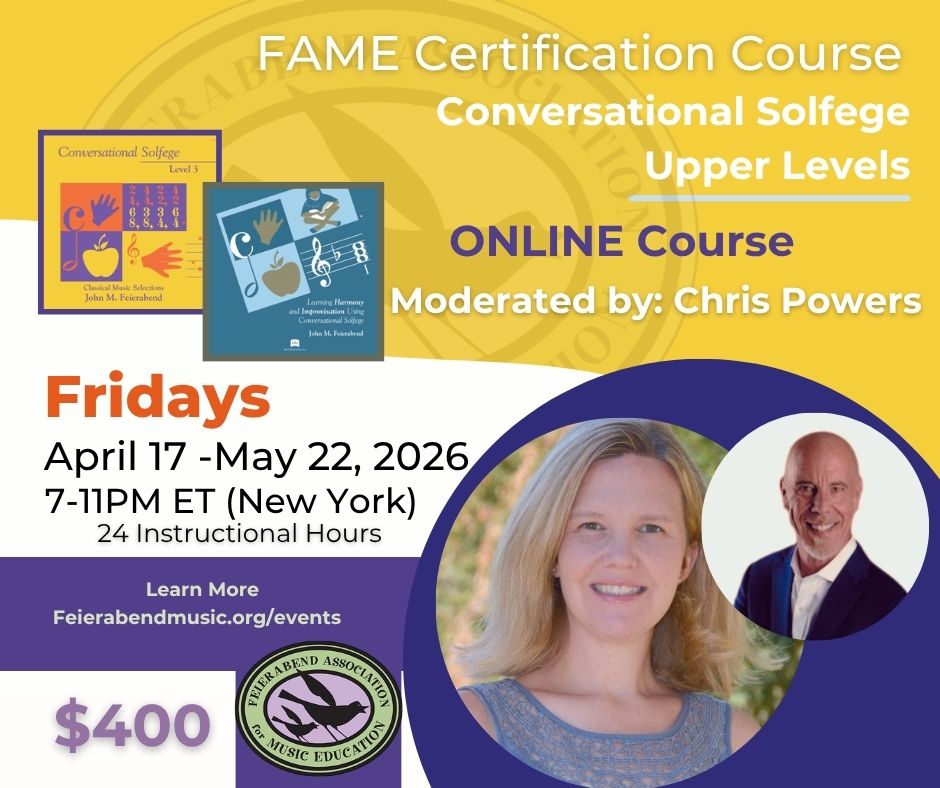
Conversational Solfege Upper Levels
Online Course – Live on Zoom
Friday evenings: April 17 – May 22, 2026
7:00–11:00 PM US-Eastern Standard Time (4:00–8:00 PM Pacific)
Conversational Solfege Upper Levels further explores the development of music literacy through analyzing songs and creating a sequence of learning, based on song content and skill development. Strategies include listening, reading, writing, writing lesson plans, and establishing yearly goals and an introduction of how to teach harmonic function in major, minor and modal tonalities as they apply to improvisation and composition.
John Feierabend’s 2018 reissued book Conversational Solfege Level 3 (a.k.a. “Upper Levels” or just “CSUL”), is the same Ear-First Approach to thinking musical thoughts that sets Conversational Solfege apart, and it’s geared towards MS/HS performing ensembles. CSUL picks up the sequence where Level 2 left off, guiding students to think, read and write in most keys, meters, and regions of the staff. CSUL also includes a curriculum to teach musicians a Conversational knowledge of major and minor diatonic harmony, and its application to teaching improvisation and composition with performing ensemble classroom. Building on the conversational skill of “discovering the baseline” to create a harmony, introduced in Lev. 2, this curriculum leads students to use a bass line to inform tonal analysis to reveal the corresponding diatonic chord tones, and the many melodic counter-puntal possibilities that weave harmony together. Come prepared to sing. This course applies to upper elementary general music, as well as middle school and high school choral, and instrumental teachers.
Applications of Conversational Solfege are ideally suited to:
-
Elementary general music curricula
-
Choral organizations at all levels
-
Orff Schulwerk, Kodály, Dalcroze, and Gordon Music Learning Theory
-
High school and college sight-singing and ear training
-
Class piano, Suzuki, recorder, band, and orchestral instruction
Participants who successfully complete all course requirements will receive an official certificate of completion for Conversational Solfege Levels 1 & 2 from the Feierabend Association for Music Education (FAME).
Fame-Hosted Course and Event Absence and Refund Policy
FAME-hosted In-Person and Online Events: If, prior to the start of the course, a participant can no longer attend, a refund can be requested. A $25 processing fee may be assessed.
Online Courses and Events: It is expected that participants will attend the online course or event live each week. In the event of an emergency (e.g. illness, personal etc) please contact the moderator directly. Once the course has begun, refunds will not be issued after a participant’s absence.
See what the virtual online class is like?
About the Moderator
CHRIS ANNE POWERS has been a music educator since 1995. She currently teaches K-5 General Music, Band, Chorus, and Theater in Greenwich, Connecticut. Chris received her undergraduate degree in Music Education as well as her Kodály Certificate from The Hartt School, where she first met and studied with Dr. John Feierabend. She is now the director of the Kodály Certification Program at the Hartt School, as well as the Methodology II and III professor. She also holds a Master’s Degree in Education from Sacred Heart University. As an Endorsed Teacher Trainer for the Feierabend Association for Music Education (FAME), Chris presents professional development workshops and FAME certification courses at universities and school districts around the country. Chris is a contributing author to the Feierabend Fundamentals book and is the author and curator of the Feierabend Repertoire Database published by GIA Publications. She has worked as a mentor and sponsor teacher assisting beginning and uncertified teachers in the TEAM program for the State of Connecticut Department of Education. She is also one of the conductors of the Fairfield County Children’s Choir and the Greenwich Public Schools Honor Choir. In 2019, Chris was the proud recipient of the Greenwich Distinguished Teachers Award.
Reviews
There are no reviews yet.